House types by borough
| Borough | Semi-detached | Terraced | Detached | Purpose-built flats |
|---|---|---|---|---|
| Wirral | 41.6% | 23.5% | 17.4% | 11.9% |
| Sefton | 46.1% | 18.4% | 16.2% | 13.6% |
| St Helens | 47.0% | 28.3% | 15.8% | 7.2% |
| Knowsley | 43.1% | 31.5% | 15.0% | 9.1% |
| Halton | 34.5% | 33.4% | 21.0% | 9.5% |
| Liverpool (comparison) | 30.7% | 37.9% | 8.2% | 17.2% |
| England and Wales | 31.5% | 23.2% | 23.2% | 16.7% |
Semi-detached houses
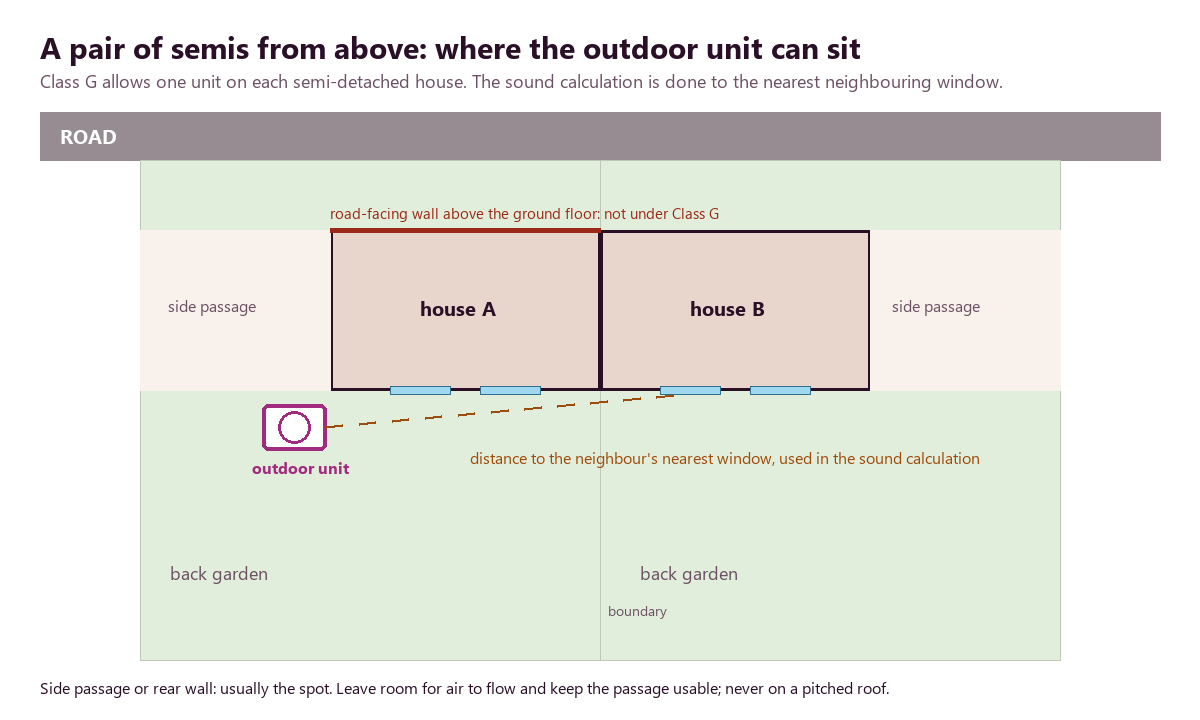
Semis are the largest group in every borough, from 34.5% of households in Halton to 47.0% in St Helens, against 31.5% nationally. Many have a side passage and a back garden, and nearly all are heated by gas. Each semi can have one air source unit under Class G. The side passage is often the natural place, close to the kitchen and the existing pipework, if there is room for air to move around the unit and it does not block access. The rear wall is the alternative.
The neighbour is the deciding factor. The MCS 020 a) sound calculation is worked out at the nearest window of a habitable room next door. On a semi, that is often the attached neighbour's rear window, a few metres away across the garden. A quieter unit, a little more distance or a solid barrier can bring the figure within the limit.
Terraced houses
Terraces make up 33.4% of Halton's households and 31.5% of Knowsley's, and a smaller share elsewhere. With no side passage, the back garden or yard is usually the only place for a unit: Class G never allows one on a road-facing wall above the ground floor, and in a conservation area nothing may face the road at all. Terraces also tend to have less room inside for a hot water cylinder, which a heat pump normally needs in place of a combi boiler.
Detached houses
Detached houses are a minority in every borough, highest in Halton at 21.0% and below the national 23.2% everywhere. They give the most freedom: space on all sides, usually more distance from neighbours, and Class G allows up to two units, which helps where a larger house needs more heat than one can supply. A large garden may also take a ground source loop, which is permitted development under Class C.
Flats
Purpose-built flats house 13.6% of households in Sefton and 11.9% in Wirral, fewer elsewhere. A block of flats can have one air source unit under Class G, no larger than 0.6 cubic metres, and the building's owner or freeholder has to agree to anything on the outside. Some blocks are on communal heating or a heat network, in which case the decision rests with whoever runs it. Converted flats in older houses, not counted in these figures, raise the same questions about ownership of the walls and roof.
Inside the house
- Radiators: a heat pump runs best at a lower flow temperature, so some radiators may need to be larger; the room-by-room heat-loss survey decides which.
- Hot water: a cylinder is normally needed. A home that had a cylinder before a combi was fitted may still have the airing cupboard space for one.
- Insulation: loft and cavity insulation lower the heat a house needs and so the size of the heat pump.
- Electrics: the installer checks the supply and notifies the network operator before connecting.